“Can you change if you can’t even remember when you fail?” Transience creators Leo Johnson and Ricardo Mo on what would happen if the whole world lost it’s short-term memory!

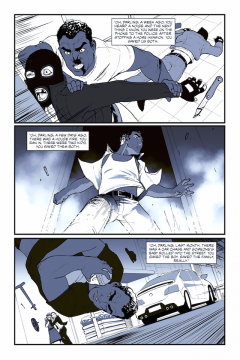
 We’ve seen plenty of anthologies in our time, and also plenty of post-event book as well, but we can’t remember seeing a post-event anthology with quite the ambition and originality as we have with Transience. Conceived by Ricardo Mo and Leo Johnson it’s a collection of stories from across the globe, in a world where the whole population has only a day’s worth of memory. We catch up with Ricardo and Leo before they forget how they came up with this unique idea!
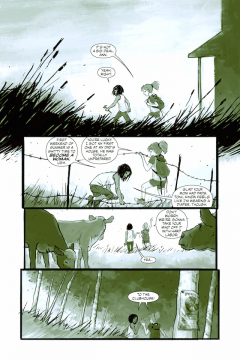
Transience has a really unique take on a post-event world, can you tell us a bit about how you came up with the idea, was the memory loss the primary idea or the idea of telling stories in the same world from a different perspective?
Ricardo: So the basic concept, of a world where pockets of the populace suffer from an inability to retain new memories, came from an interest in exploring the idea that we are all the products our experiences. Movies like Memento do a great job of examining how an individual copes when they can no longer remember new experiences and they essentially stop growing as a person. But with a single affected person, the rest of society is still there to fill in the blanks, or to help them along. We were interested specifically in what happens when everyone is Guy Pearce.
Once we had the basic concept in place, Leo and I decided we could best explore that idea in an anthology, with the help of some friends and some creators we’d long-admired. The additional minds allowed us to expand our scope and show the global consequences of these memory-bombs being detonated.
Leo: The rough idea of Transience is that biological attacks have left large chunks of the population in places all around the world with anterograde amnesia – the inability to make new memories. I jokingly like to pitch it to people as 50 First Dates with fewer Adam Sandler jokes and more existential crisis. We have all these people all over the world who can’t remember anything more recent than “yesterday”. Granted, “yesterday” might actually be a decade ago, so it’s not always a good thing. People are aging, people are dying, kids are growing up, the world is changing, but the people affected by the biological attacks don’t remember any of it. The memory loss was always sort of the big thrust of the anthology.
Transience was originally Ricardo’s idea, so he’ll probably have some story about how the thought struck him in some opportune moment or something, but where Transience became a concrete thing for me was because of an email. Ricardo sent me an email one day back in late 2015 with the basic outline of Transience. I doubt it was 100% the idea we have now, but it was close. I liked the idea so much that I told him that if he didn’t do something with the idea, I’d steal it and do something with it myself. Rather than let me steal it, he decided we should work together, with as many talented people as we could convince to help us, to make a really cool anthology.
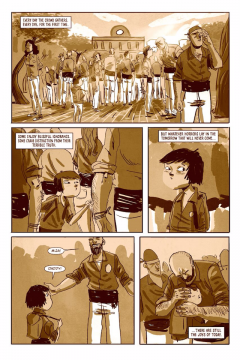
You’ve a really eclectic group of writers involved how did you select them and how much guidance did you give them on their story ideas?
Ricardo: We were really lucky that most contributors quickly got what we were trying to achieve and didn’t require much in the way of guidance. As editors, our roles were much more about finessing stories so that one didn’t contradict another. We made it clear from the beginning that, while we had a few basic thoughts, much of the world-building was yet to be done. And their input formed and transformed the book in terms of both overall structure and the finer detail. So each of our fabulous contributors is, in the truest sense, a co-creator of the world of Transience.
Leo: Assembling the creative teams was probably the easiest part of the whole experience, for me. All the creators are pretty much people whose work we already loved. Some are people we knew we wanted to work together. Like, Eric Grissom and Will Perkins, who did the fantastic Sealand story, had previously worked together on a one-shot, Gregory Suicide (which has now expanded into an OGN through Dark Horse). Ricardo and I both loved them and their work, so we knew we wanted them to work together again on this. A similar thing was the case with Ben Kahn and Bruno Hidalgo, who did the fantastic Shaman together previously. We already knew those two were an awesome team, so why not see what else they could do? Others are creators that we initially didn’t know about, and were introduced to us through other contributors. Once we saw their work, we knew we wanted to work with them too. Everyone is a creator whose work we adored, in one way or another.
As far as guidance, it varied. Some teams got things immediately and some needed a little more help before they settled into the world of Transience all the way. Some stories came to us basically as they are in the final product, while some needed a little back and forth and some changes made.
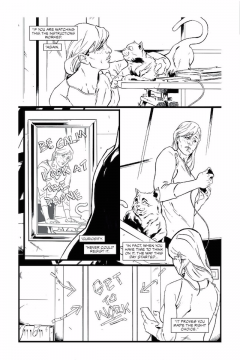
Was it important to have a real variety of writers and stories from all over the world to really get across that this a global problem?
Ricardo: (hands over to Leo, who nails the answer)
Leo: Once we decided to make this an anthology that dealt with different people all over the world, getting actual people from all over the world just made the most sense. Social media, and in our case mostly Twitter, has made it easier than ever to meet people from halfway across the world and build relationships with them. Transience has creators from six different countries on three different continents. That alone is a testament to how powerful social media is.
How did the artists get involved, did the writers pick them or did you?
Ricardo: (again stays silent in the presence of an on-fire Leo)
Leo: For the most part, we already had the artists in mind when we went into things. They were all people whose work we loved and admired. There was a case or two, like with Sam Read and Cian Tormey, where a writer introduced us to the artist they’d end up working with. Not everyone came on board in the same way, but it all worked out well for us in the end.
Did you have a set of rules or a history of the world which you worked to to keep things coherent? When I read I just kept thinking, why don’t people just stay awake to avoid forgetting things?! Or is creating those rules and exemptions part of the appeal for creating in this world?
Ricardo: As I touched on earlier, the contributors to this anthology were all making most of the rules as they went. They were building on the only the slightest of frameworks, and they all did a fantastic job of fleshing it out. Where they had a specific question, we would do our best to answer them in a way that felt true to the narrative, but didn’t crush anyone’s creativity. And I feel that these particular creators, whose hard work you see in these pages, really thrived under the conditions we fostered.
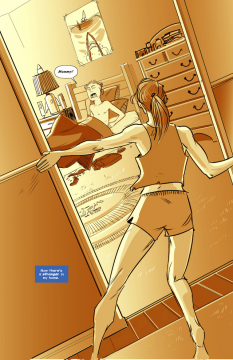
My one regret is that nobody, not even me, tackled the reluctant sleepers. If sleep makes you forget, then obviously some people would try to stay awake for as long as possible. But sleep deprivation has its own challenges and consequences. In fact, there’s probably a whole other anthology there. However, I will say that between us we covered an awful lot of ground. These aren’t just seven rehashes of the same little story, they are unique and special pieces of work that combine to present a huge narrative and take you on a complex emotional journey. We are so proud of everyone involved.
Leo: As far as staying awake, I want to say that I’ve read you can only stay awake for 11 days before you die. Assuming that’s true and the people of Transience had access to an infinite amount of uppers, living your life 11 days at a time, then forgetting it all, doesn’t really seem that much better to me than not remembering anything. Maybe that’s pessimistic, but that’s how I see it.
When it comes to rules, we started out with some rules in place, but those morphed as the process went on. Rules we started out with got scrapped as we went along because creators were pitching stories that went against those rules and the rules weren’t really that important anyway. If getting rid of a rule made for a better story without compromising the integrity of the anthology, we got rid of that rule quick.
And how did you come up with the duo tone style and one colour shading technique which holds the book together so well!
Ricardo: (defers to Leo’s greatness)
Leo: To begin with, everything was going to be black and white and we encouraged the artist to throw in some tones to help make things that much better looking. The one color shading technique is actually all Eric Grissom and Will Perkins. When they sent us their short, it was done up with the sepia tone that is has now. Ricardo and I both really liked the look of it, but then had to decide whether to make all the stories have color shading or to make their story black and white. Obviously, color won out.
The idea of losing your memory is quite a terrifying one, how do you think you’d cope?
Ricardo: I don’t think I’d cope particularly well, if I’m honest. I thought I’d thrive in a zombie apocalypse until I went on an “interactive zombie experience” and pissed my pants. We all like to think we’d cope admirably in any situation, but real life is a lot scarier and more distressing than fiction.
Leo: I think amnesia is such a popular idea in fiction because memory is already such a fickle thing even when we like to think it’s good or perfect. I honestly don’t know how I’d cope with not being able to make new memories. I’m still a pretty young guy, so I can’t imagine waking up at 40 and my last memory being of me at 25. I honestly don’t think I’d cope with that well, essentially losing years of my life and having no memories of that. With Transience we get to explore that some. If you can’t make new memories, do you essentially stop growing as a person? If you can’t remember what you’ve done before, do you get stuck in the same loop? Can you change if you can’t even remember when you fail?
The book is hitting kickstarter soon, What can we look forward to and will we be seeing more Transience stories in the future?
Ricardo: Backers of the Kickstarter can look forward to getting a great-looking, great-reading anthology on their digital devices within days of campaign’s end.
As for more Transience stories, never say never. If enough people demand something, there’s usually scope to make it happen. Step One though is convincing readers to drop $4 on 56 pages of gorgeous, thought-provoking comics… seems like a no-brainer to me!
Leo: It’s live now! We’re keeping things simple and running a digital-only campaign with one reward: a digital copy of the anthology. Ricardo and I are both big believers in digital, so we want to do a simple, digital campaign and see how it does for our first outing on Kickstarter. With the anthology already done and it being digital, we can send out the PDFs as soon as the campaign is done, with no hassle for our backers and no extra junk that they might not really want. Even better, the funds raised, after fees and all that junk, are going to go straight to paying the various contributors. Just our way of making sure that everyone gets at least a small portion of what they’re worth. The more successful the campaign is, the better paid everyone is.
In a world where all our dreams were reality, we’d be able to do more Transience because the support and money would be there. If this whole thing goes well and we do better than expected, maybe next year we’ll be talking to you about Transience 2: The Quickening.
You can back the Kickstarter for Transience here


