“I think webcomics still have that sense of frontier freedom” Brian Fies discusses The Last Mechanical Monster, his Eisner-nomination and the history of webcomics

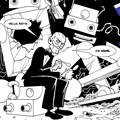 As part of our build up to this year’s Eisner Award for Best Digital / WebComic we talk to Brian Fies, create of The Last Mechanical Monster. Fies is no stranger to the Eisner Award for Best Digital Comic, having won the inaugural prize back in 2005 for his emotive series ‘Mom’s Cancer’. This year he is nominated for the very different work, The Last Mechanical Monster is the tale of a mad scientist from a 1930s Max Fleischer Superman cartoon who is released from prison in the present day only to go in search of his last remaining fire-breathing flying robot. It’s brilliant mix of post-modernism with a generous dose of nostalgia so we contacted Brian to find out more about how this project came about.
For readers new to The Last Mechanical Monster can you give us the ‘elevator pitch’ explaining what it’s all about and why readers should get excited about it?
BF: It’s about a very old inventor who, sixty-four years after his greatest triumph and failure, discovers he has one giant robot left to leave his mark on the world. What that mark will be, and how the inventor’s ideas about it change, drives the story. It’s about mortality, creativity, legacy. How do you want to be remembered?
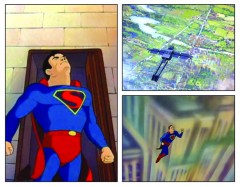
The opening screens are based around an old Max Fleischer Superman cartoon, how did you get around the legality of including Superman in your story?
BF: I’ve always loved the Fleischer cartoons, considered by many a benchmark in high-quality animation, but don’t remember when I had the idea to use one as a departure point for my story. I’ve been mulling it over for years. Many of the old Fleischer cartoons (Superman, Betty Boop, Koko the Clown) are in the public domain, meaning that their copyright has lapsed, which led to them being endlessly shown on U.S. children’s TV programs. As I explained in my Author’s Note, that doesn’t mean anyone can just make their own Superman cartoons. Superman, Clark Kent, Lois Lane and the rest are still owned, copyrighted, trademarked, etc. by DC Comics, and my webcomic won’t touch them. Aside from the introductory panels, which are taken from the 1941 Fleischer cartoon, I’m only using the Inventor and the Robot, which the Fleischers created. I believe I’m on solid legal and ethical ground.
Tell us a bit about the process of taking the cartoon screens and including them in your webcomic? (You can watch the original here) Was there much tidying up and digital trickery involved to get it to work? And
BF: Technically, when I started this project a while ago, most available versions of the Fleischer “Superman” cartoon were very poor multi-generation prints that had been shown over and over, and sold in the dollar bin at discount stores. But to my good fortune, Warner Brothers recently did a digital restoration of the cartoons and made them available through YouTube and iTunes. The latter provided very crisp screen captures for my intro, which I didn’t manipulate much beyond cropping.
What made you decide to publish The Last Mechanical Monster? Was it the success of your previous work that made you choose this format?
BF: I’m debating how honest I want to be…! I did in fact propose “The Last Mechanical Monster” as a book project, and got some interest but no solid offer. Since I felt compelled to do the story one way or another, the only question was how I was going to get it out. Given my history with “Mom’s Cancer,” taking it to the Web was a natural and felt like returning home. I love reader interaction and wish I had more. Readers make excellent editors, and have already raised questions and issues I hadn’t considered and might revise my story to address. Another advantage of being a webcomic is that it’s a living document that can be edited.
You often comment on the posts giving extra insights and interacting with readers directly via the comments section, which makes it almost feels like a director’s commentary, is that another part of the appear for web comics vs. print?
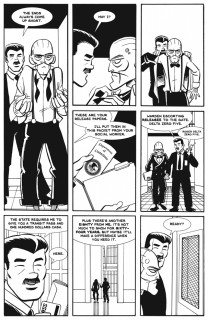
BF: Your comparison to a director’s commentary is apt, and deliberate. Some readers really like learning about the process of making comics and how I think about solving different problems, and as long as the discussion doesn’t pull readers out of the story I enjoy sharing my thoughts.
Aside from being a means of telling the story, I approached this webcomic as an experiment. Webcomics have become quite an industry of their own, with business strategies, search engine optimization, dedicated portals, hosting packages, and so forth. It’s become very complicated! My experiment was to see if it’s still possible to do it simply and cheaply: post black-and-white drawings on the Web at no cost. That’s why I put it on Google’s free Blogger instead of a customized host/platform better suited to webcomics—if I could do it on Blogger, anyone could. To the extent the comic has drawn readers and recognition, culminating in its Eisner nomination, the experiment has been a success. To the extent I’ve made a penny from it, it hasn’t (nor was it expected to—part of the experiment was to decline ads or donations). “If you build it, will they come?” It’s sort of a test of faith. The experiment’s not over, but I’m encouraged.
The scenes in the modern day have a very Bruce Timm/Darwyn Cooke feel to them, did you tweak your style to match the content or were you more inspired by the classic Fleischer era artists than anyone contemporary?
BF: Thanks for the comparison, which I take as a high compliment. Interesting: I’m sure if you asked Timm or Cooke they’d say that their styles were inspired by the Fleischer artists. We all looked to them. I did tweak my style to mimic the Fleischers to the degree I could, keeping in mind that I’ve really just got the one style in the first place. There’s a clarity, dynamism and directness to their work I try to keep in mind. Fairly simple forms, since they had to be drawn by animators several thousand times. For example, the Robot is easy to draw—all rectangles and cylinders—and I sometimes feel a real kinship with the Fleischer animators across the decades as I ink it. “I see what you guys did there, very clever!” If I get a chance to color the comic someday (possibly to “add value” in some version people might pay for), I think I’d try to reproduce the Fleischers’ lush, shaded watercolor look as best I could, which would help tie them together visually.
You’re an old hand when it comes to the ‘Best Digital Comic’ Eisner Award having won the first Best Digital Award in 2005 for Mom’s Cancer, how do you think digital comics have evolved in the last 10 years and do you think it is a stronger genre now than it has ever been before?
BF: Oh yes, much stronger. Many more webcomics, with some amazing high-quality work being done by extremely talented people. Very intimidating! Ten years ago, webcomics felt to me like the lawless Wild West. I think webcomics still have that sense of frontier freedom, but maybe the railroad and a schoolmarm have come to town, and things are settling down a bit. Not quite as many gunfights in the street.
Now I’m going to pontificate on a topic I don’t know much about. My impression 10 years ago was that nobody quite knew how to do webcomics—how to find and build an audience, how to make some money at it. Fundamentals such as “post new content on a reliable schedule” hadn’t really been codified. Now there are a lot of successful examples to follow, and even a couple of books that purport to share the secrets. You can look around and say, “I could do it like Scott Kurtz or Kate Beaton or Allie Brosh,” those models exist today.
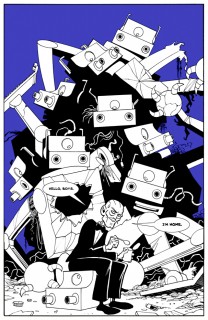
For me, the fundamental strength and weakness of webcomics, which is the absence of gatekeepers, hasn’t changed. Anybody can publish anything.That’s their glory and their curse. Per Sturgeon’s Law, most of it is garbage. The only way I know of to sort good from bad is word of mouth, which is incredibly powerful but, given popular taste, not always reliable. I think getting a webcomic in front of the right reader who might enjoy it remains a huge challenge. And despite a few success stories, so does earning a few dollars for your effort.
How did producing Last Mechanical Monster compare to your personal work like Mom’s Cancer? Which do you prefer doing or do you not have a preference?
BF: Nothing I ever do will compare to the process or result of working on “Mom’s Cancer,” which was incredibly hard and incredibly rewarding. Immodestly, my family’s story has actually helped people and made a small difference in the world, which I don’t think a lot of comics can say.
I have high standards for “personal work” in comics. I have little patience for whiny, nihilistic autobiography by directionless twenty- or thirty-somethings who just realized the universe doesn’t love them. What I do treasure are stories by people who’ve gone on to define their own purpose in life. Those are unique and compelling! In that context, I have no plans for further personal work because I don’t think my life is that interesting. Unless you’re a battlefield journalist or a refugee from revolutionary Iran, your life isn’t that interesting, either. Nobody cares. Find something outside yourself to write about.
Having said that, my second graphic novel, “Whatever Happened to the World of Tomorrow,” was very personal in the sense that it was about growing up a Space Age kid and wondering what happened to that sense of can-do optimism I was born into. I’m not in the book, but anyone who reads it knows more about me than friends I’ve had for 30 years. If you’re going to bother creating a story, it should be about something very important to you. It just doesn’t have to be about you.
What I love about producing “The Last Mechanical Monster” is that it’s fun. Yes, comics can be fun! Strange concept, I know.
What are your thoughts on the other Eisner nominees and were there any titles that you would like to have seen nominated that weren’t?
BF: Good sportsmanship prevents me from saying in public what I might say if you and I were sharing a pint. That said, as I recently explained on my blog (http://brianfies.blogspot.com), I’m sure “The Oatmeal” is going to win this year, if only because it has 10,000 times as many readers as the rest of us.
Likewise, I wouldn’t want to say anything to second-guess or insult the Eisner judges, who have an incredibly difficult job. However, I was surprised the list of nominees was missing one or two webcomics in particular.
What the Eisner nomination means to me is that, on the day those six expert judges looked over the webcomic candidates they had in front of them, some majority of them thought mine was one of the five best. Reading much more into it than that is foolishness. That’s satisfying enough for me.
You can read The Last Mechanical Monster here and to read more of Brian’s work visit his blog here.


December 21, 2025 @ 8:05 am
Ein Blick in die Kristallkugel (das Scatter-Symbol dieses Slots – ab drei Symbolen gelangst du in den Freispielmodus, in dem du gleich
zehnmal hintereinander spielen kannst) verhilft hier zu sagenhaften Schätzen! Zusammenfassend kann man sagen, dass es keinen besseren Ort im Internet gibt, wenn
Sie kostenlose Demo-Spielautomaten zum Spaß spielen möchten. Mit der
Entwicklung des virtuellen Glücksspiels begann ihr Einflussbereich, Webseiten mit Glücksspielen einzubeziehen.
Am Mittwoch gibt es den Freispiel-Alarm, wo Spieler 100 Freispiele für die richtige Einzahlungssumme gewinnen können. Typische
Bonusangebote der besten Online Casinos sind der Bonus für die erste Einzahlung,
Freispiele oder eine Kombination aus beidem. QueenSpins beispielsweise bietet
exklusive Spiele von renommierten Anbietern wie
Merkur und Novomatic. Jeder dieser Anbieter bringt einzigartige Vorteile
mit sich und bietet deutschen Spielern erstklassige Unterhaltung.
References:
https://online-spielhallen.de/bitkingz-casino-mobile-app-dein-gaming-konigreich-fur-unterwegs/
December 26, 2025 @ 6:13 pm
Sky crown casino developed this cashback system after
seeing how quickly bankrolls can disappear during unlucky sessions.
Use these funds immediately on any game across the platform.
The system handles everything behind the scenes – calculating losses and crediting the bonus without any action required.
Players wake up to find 10% of net losses returned directly to their
casino account. After a rough streak at Sky crown casino,
the sting hurts less knowing some money comes
back automatically. When you continue your journey after
the first deposit, even more rewards await you.
Add in smooth gameplay, a safe environment, and local-friendly terms, and
it’s no surprise that more Aussie players are checking out what SkyCrown has to offer.
On top of that, the welcome package is clear and simple, giving you extra spins and bonus cash
to test the waters. Skycrown Casino is a cutting-edge online
gaming site established in 2022.
All the deposits with these options are instant.
Choose whatever suits your current mood and enjoy not just the thrilling atmosphere of games, but
also real money winnings! SkyCrown Casino counts more than 10,000 titles of games.
Always remember to read all the terms and conditions before gambling at SkyCrown Casino.
Finally, the validity of each welcome bonus part is 14 days.
Moreover, maximum win and cashout is FS wins cap A$300; bonus cashout cap A$5,000.
References:
https://blackcoin.co/best-fast-payout-casinos-in-australia/
December 27, 2025 @ 10:16 am
There were no licensed casinos in Australia when the Hobart opened
its doors in 1973, which is almost impossible to believe.
The Wrest Point Casino, located on the Hobart Waterfront in Tasmania, features everything
you desire in a gaming establishment. Other amenities include 4 bars/lounges,
a health club, and a snack bar/deli. Located in Sandy
Bay, this luxury hotel is within 2 mi (3 km) of
Salamanca Place, Salamanca Market, and Constitution Dock.
The iconic Tower offers Deluxe Harbour and Mountain View rooms, each featuring
king-sized beds, modern amenities, and panoramic vistas of Hobart’s skyline or the
majestic kunanyi / Mount Wellington. We have exceptional accommodation options for groups and corporate
guests.
Check out our top-rated Internet blackjack gaming sites if you are located outside of
Australia. For those who are based elsewhere, the real money casinos on this page are all accessible
via both mobile and desktop. Because of these laws, we choose not to promote real money blackjack games to
this part of the world. Country Club Tasmania was opened in 1982 and boasts
an 18-hole championship golf course as well as a premier golf driving
range. Blackjack tournaments are also a chief feature at the Country Club Casino, typically boasting a minimum $3,000
prize pool (often much more) and also organised in a three elimination heats then finals table format (scheduled at specific times).
References:
https://blackcoin.co/spanish-21-rules/
December 29, 2025 @ 6:06 am
paypal casino sites
References:
matchup.id
December 29, 2025 @ 6:29 am
online casino that accepts paypal
References:
allgovtjobz.pk